Rosetta Stone vs Duolingo for Chinese: Which Is Better in 2026?
One is the world's most downloaded language app. The other has been selling immersion since the CD-ROM era. For Mandarin specifically, they fail and succeed in very different places. Here's the honest breakdown — tones, characters, grammar, motivation, and price — so you can pick the right one for your goals.

Gabriel Uribe
Founder, Daily Chinese Stories
Table of Contents
Rosetta Stone vs Duolingo: Quick Comparison
The short version: Duolingo wins on habit-building, character drills, and price. Rosetta Stone wins on pronunciation feedback and structured immersion. Neither gets you past intermediate on its own.
| Category | Winner | Why it matters for Mandarin |
|---|---|---|
| Pronunciation and tones | Rosetta Stone | TruAccent speech recognition gives immediate feedback; Duolingo's speaking exercises are easy to pass with sloppy tones. |
| Chinese characters | Duolingo | Dedicated hanzi drills with stroke order and matching exercises beat Rosetta Stone's in-context exposure. |
| Grammar explanations | Duolingo | Neither app is great here, but Duolingo's guidebooks explain patterns; Rosetta Stone deliberately explains nothing. |
| Daily habit and motivation | Duolingo | Streaks, leagues, and five-minute lessons are unmatched for consistency — the #1 predictor of progress. |
| Value for money | Duolingo | The free tier covers the whole Mandarin course; Rosetta Stone is subscription- or lifetime-only. |
| Best overall for serious study | Rosetta Stone | If you'll show up daily without gamification, its structured immersion builds a deeper foundation. |
1. Introduction
Type "learn Chinese app" into any store and these two dominate the results. Duolingo is free, green, and relentlessly fun. Rosetta Stone is the legacy premium brand your parents might have bought on CD-ROM. Both teach Mandarin — but Mandarin punishes weaknesses that don't matter much in Spanish or French: tones, a non-phonetic writing system, and listening comprehension that takes hundreds of hours to build.
I've spent years helping learners bridge the gap from "app beginner" to actually reading and understanding Chinese, and the same pattern shows up constantly: people pick the wrong app for their situation, stall, and blame themselves. This comparison is about matching the app to your actual goals and personality — not declaring a universal winner.
Quick Verdict
Duolingo is the better starting point for most people: free, habit-forming, and surprisingly good at early character recognition.
Rosetta Stone is the better study tool for disciplined learners who want pronunciation feedback and full immersion — and don't need streaks to show up.
2. How Each App Teaches Mandarin
Rosetta Stone Approach
- • "Dynamic Immersion": no English, no translation — you infer meaning from images and context
- • TruAccent speech recognition scores your pronunciation on every speaking exercise
- • Structured units covering speaking, listening, reading, and writing in a fixed sequence
- • 25–30 minute core lessons; feels like a study session, not a game
Duolingo Approach
- • Gamified path of bite-sized lessons: translation, matching, listening, and speaking drills
- • Dedicated hanzi section with stroke order and character-pinyin matching
- • Streaks, XP leagues, and reminders engineered for daily consistency
- • 5–10 minute sessions; free with ads, or Super Duolingo to remove them
The philosophical difference matters more for Mandarin than for European languages. Rosetta Stone's no-translation immersion works well when you can guess meaning from cognates — but Chinese has none. Early lessons can feel like deciphering a puzzle. Duolingo hands you translations constantly, which feels easier but lets you "complete" lessons without ever really parsing the Chinese.
3. Key Comparison Factors
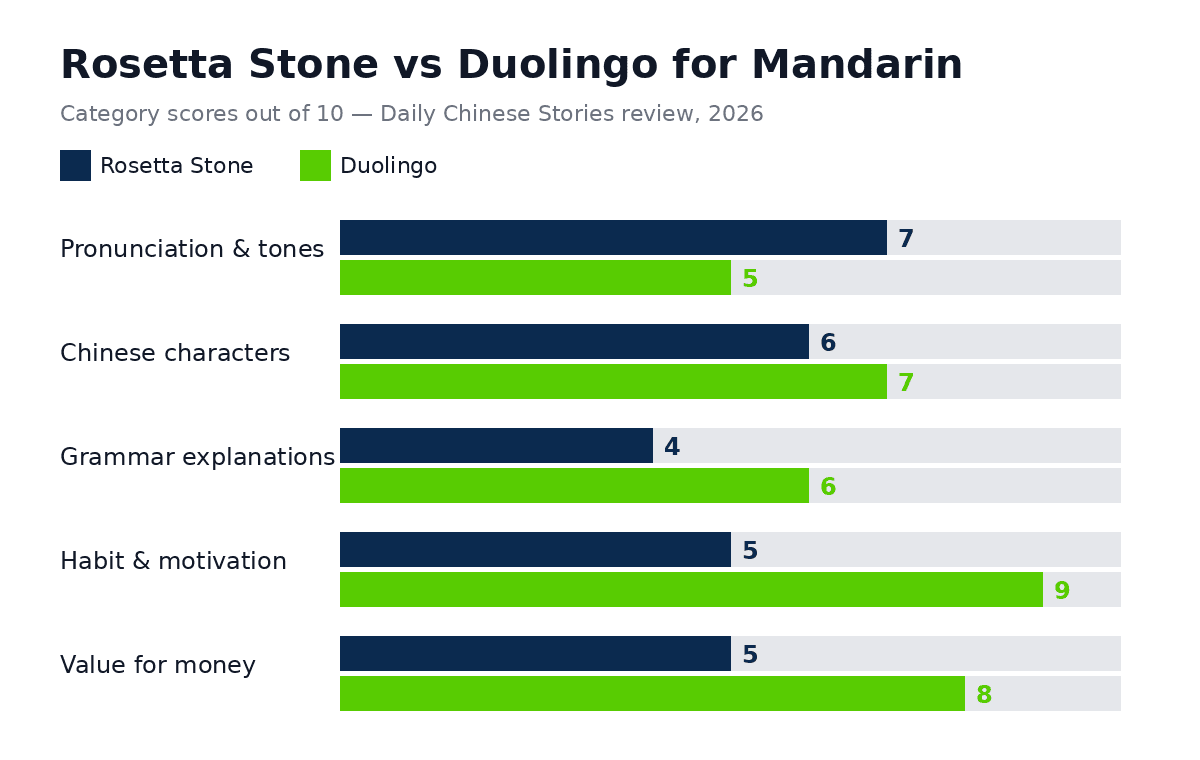
Pronunciation and tones — Rosetta Stone, 7/5
Tones make or break early Mandarin, and this is Rosetta Stone's clearest win. TruAccent listens to every repetition and pushes you to match native audio. It's imperfect — no software fully replaces a human ear — but it forces you to say everything out loud, repeatedly. Duolingo's speaking exercises accept approximations so readily that many learners develop toneless habits that take months to unlearn.
Chinese characters — Duolingo, 7/6
Surprising winner. Duolingo's Chinese course includes a dedicated hanzi tab with stroke-order tracing and character-sound matching, and lessons let you toggle between pinyin and characters. Rosetta Stone shows you characters in context (with optional pinyin), which builds recognition, but it never drills them systematically. Either way, you'll eventually want spaced-repetition flashcards and real reading practice.
Grammar explanations — Duolingo, 6/4
Mandarin grammar is genuinely different — 了 alone confuses learners for years. Duolingo's unit guidebooks give short, readable pattern explanations. Rosetta Stone gives you nothing by design: you're supposed to infer the rules. With zero cognates and unfamiliar word order, many learners infer them wrong.
Daily habit and motivation — Duolingo, 9/5
Nobody does behavioral design like Duolingo. Streaks, leagues, an aggressively guilt-tripping owl — it's easy to mock and it absolutely works. Consistency beats intensity in language learning, and if the choice is ten minutes of Duolingo every day versus Rosetta Stone abandoned after three weeks, Duolingo wins by a mile. Rosetta Stone assumes you already have the discipline; its progress tracking is functional but joyless.
Value for money — Duolingo, 8/5
Duolingo's entire Mandarin course is free with ads; the paid tier mostly removes friction rather than adding content. Rosetta Stone requires a subscription or a lifetime license — regularly discounted, but never free. If budget is the constraint, this category alone decides it. If you'll actually use the speech feedback daily, Rosetta Stone's price buys something Duolingo doesn't offer at any tier.
4. Pros & Cons
Rosetta Stone
Pros
- ✓ Best-in-class pronunciation feedback (TruAccent)
- ✓ Structured, distraction-free immersion
- ✓ Trains you to think in Chinese, not translate
- ✓ Lifetime option ends recurring fees
Cons
- ✗ No-translation method is rough with zero cognates
- ✗ No real grammar explanations
- ✗ Repetitive lesson format; easy to burn out
- ✗ Paid only
Duolingo
Pros
- ✓ Free tier covers the full Mandarin course
- ✓ Unbeatable at building a daily habit
- ✓ Dedicated hanzi drills with stroke order
- ✓ Guidebooks explain grammar patterns
Cons
- ✗ Weak tone training; sloppy speech passes
- ✗ Sentences can be unnatural or oddly translated
- ✗ Most learners plateau around HSK 2–3
- ✗ Gamification can reward streaks over learning
5. Who Should Use Each App?
Choose Duolingo if you…
- Are testing whether you'll actually stick with Chinese before spending money
- Struggle with consistency and need the streak to show up daily
- Want early character recognition alongside vocabulary
- Have only 5–10 minutes a day right now
Choose Rosetta Stone if you…
- Care about pronunciation and want software that pushes back on your tones
- Can commit to 25–30 minute focused sessions without gamified rewards
- Prefer one structured curriculum over a game-board of lessons
- Would rather pay once (lifetime) than subscribe forever
Honestly? Consider Pimsleur instead if…
Your main goal is speaking. Neither of these apps matches Pimsleur's audio-recall method for conversational Mandarin — we compared it head-to-head in our Pimsleur vs Rosetta Stone review.
6. Verdict & Recommendations
For most beginners: start with Duolingo. It's free, it will actually get you to show up every day, and its character drills are better than its reputation suggests. Set one rule to protect yourself from its biggest weakness: say every sentence out loud with exaggerated tones, even when the app doesn't ask you to.
Upgrade to (or add) Rosetta Stone once you know you'll study daily and pronunciation starts to matter — usually a few months in, when you notice native speakers can't understand your second-tone-that's-actually-third-tone.
Whichever you choose, plan your exit. Every app course ends around lower-intermediate. The learners who break through the plateau are the ones who move from drills to input: graded reading, real listening, and content they actually enjoy — like the Chinese shows and movies on Netflix we cover here.
7. Frequently Asked Questions
Is Rosetta Stone or Duolingo better for Mandarin in 2026?
Duolingo for a free, habit-forming start; Rosetta Stone for structured immersion with pronunciation feedback. Match the app to your discipline level, not to marketing claims.
Can Duolingo actually teach you Chinese?
It can take you from zero to a solid beginner level — basic characters, core vocabulary, simple patterns. Expect a plateau around HSK 2–3 unless you add real listening and reading practice.
Which teaches Chinese characters better?
Duolingo, narrowly — its hanzi drills include stroke order and sound matching. Both apps eventually need to be supplemented with spaced repetition and graded reading.
Is Rosetta Stone worth the price for Mandarin?
Only if you'll use the speaking practice consistently. If you're unsure, start free with Duolingo and invest once your daily habit is real.
What should I use after finishing an app course?
Graded readers, native audio, and shows with subtitles. The jump from app drills to real Chinese is the single biggest filter in Mandarin learning — daily reading input is how you cross it.